Posts

Showing posts with the label Parks & Gardens

On my walk ... the parasol mushroom
Image
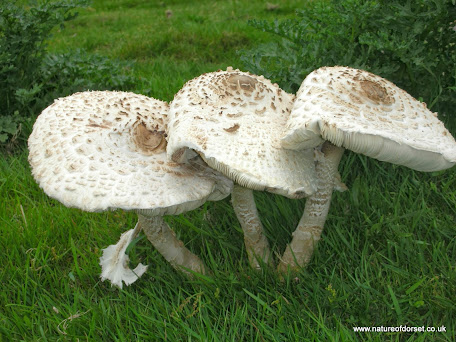
The fields up at Combe Farm on Salcombe Hill currently have a display of these, the parasol mushroom [ Macrolepioate procera ]. Sadly, when I was there the specimens were past their best so I raided my photograph library for this picture. It is both one of the most distinctive species of fungi through its large size, the caps can sometime be nine or ten inches across, and one of the most common, well in the south of England that is, it is less common in the north. That said, there are some similar species which are less common. This is primarily a species of grasslands, especially amongst the short grasses of parkland and grazing pasture but it does occur in woodlands along open paths and rides as well.  My book says this makes excellent eating but accurate identification is essential; I think I will err on the side of caution and give them a miss.

On my walk ... the wood pigeon

Image
  This is a common sight almost everywhere it seems, the wood pigeon is one of the most widespread of species despite its name seemingly linking it to woodland. The RSPB places the wood pigeon at number 4 in its top 10 garden birds. At a time when the population level of almost all British species is falling the wood pigeon seems to be prospering. When the first 'birdwatch' was held back in 1979 the wood pigeon placed at 18th. Ten years later it was up to 13th and by 1999 it had risen to 10th. The rise of the wood pigeon seems to be relentless! It is obvious, of course, that if the populations of other birds are falling the numbers of wood pigeon could remain the same and it would still rise up the RSPB charts and that is undoubtedly a contributory factor but there will be other factors too that have 'probably' seen the numbers increase. I say 'probably' because I have not found any census data that actually confirms the population is, indeed, increasing. I susp...

On my walk ... the grey squirrel

Image
  You do not have to walk far around the parks and paths of Sidmouth town to encounter one of these little chaps; it is, of course, a grey squirrel [Sciuurus carolinensis] . Indeed, I do not actually have to walk at all to encounter them, I can watch them from my window. It is such fun to see them bounding across the lawns always in a hurry,  it is interesting to watch their territorial disputes and family arguments and at this time of year it is enchanting to watch them with a chestnut in their mouth looking for a 'secret' place to bury it.  Some people love them, some even feed them. Others hate them and abhor the way they raid bird feeders and steal what is meant for robins and blue tits despite the barriers that may be put in their way, they are known for being intelligent and resourceful creatures. Love them or hate them, they seem to have become part of our 'natural' fauna. I am sure we all know that the grey squirrel is not a native species to the British Isles. ...

On my walk ... the autumn hawkbit

Image
  As I stride the streets of Sidmouth getting my daily (well, almost  daily) exercise I pass lawns and other grassy places that are kept short and often, at this time of year, they are covered in dandelions. Well I say 'dandelions' as that is what we tend to call all of this king of yellow flower that we see. Whilst you can see 'real' dandelions at any time of year they are most common in spring and early summer, but by October they are less so obvious so that begs the question, what are these 'dandelions' that can be seen commonly in October? Look in any wild flower book and you will see several pages of 'dandelions', my favourite book has illustrations of 36 species that all look the same! However, when you look more closely you start to see differences which, if you feel you want to name them, give you clues. So why is this photograph not of a dandelion? Firstly, the flower head is smaller than a dandelion; it has a shorter diameter and less densely p...

For my walk ... the Knowle

Image
  For my walk on Sunday afternoon I thought I would take a closer look at the Knowle which I previously paid a casual visit to about a month ago, not long after I arrived here in Sidmouth. As far as I can tell this area is the garden of Knowle House which was once one of the most prestigious houses in Sidmouth with extensive gardens but subsequent conversion into a hotel and then to East Devon Council offices has meant some of the grounds have been lost to the enlarged building and areas of access road and car parking. The house is now empty but I see has been acquired by McCarthy and Stone for conversion into luxury apartments for the over 60s. The gardens are currently a public park but whether this will change with the new development I do not know. Anyway, to the natural interest of the site which is why I visited. The area seems to fall into two sections; the 'formal' gardens to the front of the house and a more 'informal' section alongside the main road from the t...