Posts

Showing posts with the label Shoreline

On my walk ... the rock samphire

Image
  Walking the paths by the sea even though it is getting late in the season it is still possible to see this 'iconic' flower of the seaside, rock samphire [ Crithmum maritimum] . It is one of those plants that seems capable of growing in the most extreme conditions and, indeed, only grows in extreme conditions, on rocks, walls, shingle and barren conditions exposed to the weather and sea spray. Rock samphire looks as though it is not quite in flower even when it is! The flowers are cream or green and are umbrella shaped which is quite typical of the carrot family to which it belongs. Unlike other carrots however the leaves are very fleshy and this helps it store moisture and so thrive where other flowers cannot. It is also known as sea fennel and sea asparagus or just plain samphire but the name samphire is also used for other seaside plants such as glasswort. There is also a golden samphire which is totally unrelated.  This was once a popular food plant and was harvested and ...
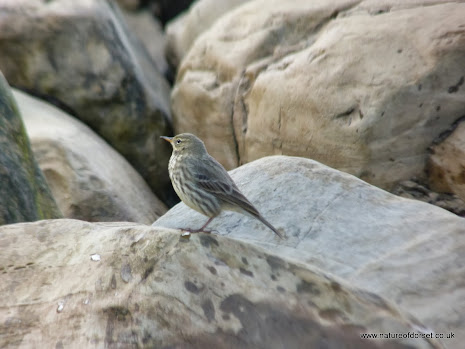
On my walk ... the rock pipit

Image
  As you walk along the Clifton Walkway from the end of the prom towards Jacobs Ladder you will often encounter active little brown birds flitting around amongst the sea defence rocks. These are what are known in birding circles as LBJs, 'little brown jobs', and they are one of several species that are similar but these are rock pipits. The pipits are all much the same really, streaky brown back with a 'thrush-like' spotted front. Telling rock pipits from other members of the family can be a bit daunting until you realise that rock pipits are found amongst rocks, meadow pipits in grassy habitats and tree pipits in trees. If only it were that simple for some other species; a garden warbler in a garden for example? I don't think so! Rock pipits and water pipits are named as separate species but are often considered to be the same but water pipits are usually found inland at fresh water sites in winter only. They often occur in places like watercress beds. Like other p...

On my walk ... the turnstone

Image
  One of my favourite encounters as I walk along the seafront in Sidmouth is with the small flock of turnstone that can frequently be seen on the beach or on the rock sea defences. There are about twenty in the group and in autumn and winter they certainly flock together being birds of a feather. Turnstone are what are termed 'waders' and are distant relatives of the sandpiper family but although they are 'waders' you never see them wading. They are very much a bird of the shoreline resting on rocks and walls at high tide, scouring the beach when it is available to them and then, at low tide, examining rock pools and exposed seaweed.  The turnstone gets its name, of course, from its distinctive feeding habit of turning stones over to raid any grubs that might be hiding underneath but they also are adept at turning over seaweed and can often be seen rummaging around the tide line where drying weed and debris attract flies. On the beach in Sidmouth they run around between...

On my walk ... treacle mustard

Image
  Being a new arrival in Sidmouth I am discovering that my new surroundings are very different from where I have lived previously. The geology here, the different habitat types that it creates and so the species one sees means that there is always potential to find something I have not seen before.  This is treacle mustard [Erysimum cheiranthoides], it is a member of the cabbage, or cruciferae, family; it has four petals which is a characteristic of this group of plants. It is a low growing annual plant with cylindrical seed pods and it is the seed pods that help distinguish it from related plants. It favours bare ground, according to my field guide often occurring in sandy locations, and flowers from June through until September. The name 'treacle' mustard came from the Greek, theriaki, meaning antidote to poisonous bites as the plant was thought to have healing properties (Wikipedia). Research has shown the plant, like many of the cabbage family, contain chemicals which giv...

On my walk ... the herring gull

Image
  On any stroll along the prom in Sidmouth you will see herring gulls. Despite popular belief herring gull populations are in decline as they struggle with diminishing natural food supplies and nesting habitats. They have become quite resourceful and have adapted their behaviour to nest on roof tops and to scavenge for scraps that humans leave behind although that scavenging seems to be reaching the point where they will boldly take food before humans have left it behind! The herring gull is a stocky bird and not something one would wish to tangle with especially when it is in the air near you and in some places it is claimed visitors are staying away because of the gulls. In Swanage recently a local started a petition to try and get the town council to 'cull' them as they are considered to be a nuisance. It is, I think, a shame that we humans act in a way that encourages animals to become what we then consider to be a nuisance and then our answer is to want to kill off the poo...